Search This Blog

Tuesday, April 27, 2010

What I learned from EDU class...*


After taking this class I've realized that I do have a passion for helping others out, and that there is a strong possibility that I want to eventually teach someday. I have learned about what it takes to become a teacher, including doing extra research on MTELs and even looking into taking more education courses after getting into a Masters program for English. I had never really given much thought in finding a career in Education but after reading all the articles, and having such meaningful discussions in class I felt a pull towards learning more. I have always had a passion for helping others out, so by furthering myself and possibly teaching at a college level someday would be so rewarding.
This course taught me the basic steps and exams to become a teacher and so much more. The readings from both books we used in class seemed to really show how teachers can make a difference in students lives, along with all the different methods and schools of teaching you can move into.
One thing I found myself doing as the semester went on was really focusing in on my professors in class, to see which techniques they used in class discussions. I also found myself looking back to my earlier years of school and seeing how much of an influence my teachers had on my education now as I am graduating college.
I think this class is a great opportunity for all students, not just education majors or prospective teachers to take. This semester taught me that teaching requires so much, and that teachers deserve more credit than they get for dealing with diversity and continuing to better the future education of children.

If a doctor, lawyer, or dentist had 40 people in his office at one time, all of whom had different needs, and some of whom didn't want to be there and were causing trouble, and the doctor, lawyer, or dentist, without assistance, had to treat them all with professional excellence for nine months, then he might have some conception of the classroom teacher's job. ~Donald D. Quinn

Tuesday, April 20, 2010

John Dewey


I chose to research John Dewey because out of all the people on the list his name struck me as interesting, and I did not know much about him at all. Through quick research I found out that he was a well known educator and philosopher who was very strongly opinionated about many things.
John Dewey's official story is that he was an American educator, philosopher, psychologist as well as a social critic and political activist. He was born in Burlington, VT on October 20, 1859 and spent his time growing up there and eventually furthering his own education. He attended and graduated from the University of Vermont and went on to get his PhD from John Hopkins University. After this he taught at the University of Michigan and later went to the University of Chicago and was elected president of the American Psychological Association. Dewey taught for several years and lectured in other countries. He was passionate about American social issues and was “outspoken on education , domestic and international politics, and numerous social movements”.

Education is life itself.
-John Dewey


John Dewey's educational philosophy was one that focused on students actively learning in order to better understand their environment. In my research I also found that Dewey's belief in education "must engage with and enlarge experiences" supports his ideas of active learning. His concern for student progress is also shown through his use of the Information-Process learning model from the McNergney text.
Another interesting fact about Dewey is that in his quest to pursue the further education of students, he wanted them to be taught civic education. Since he was so passionate about politics and civic engagement himself, he thought of it in students best interest to be educated about the world and government around them.

I like Dewey's ideas because they seem to promote the education of students which is obvious, but what I also appreciated was that he was so ardent about civic education and I think that this is an important issue that schools are facing still today.

Tuesday, April 13, 2010

Baking a Cake


Education is like baking a cake from scratch the ingredients are easy to find, but it’s how you mix them together that counts the most. The flour, sugar, and eggs represent the fundamentals of learning. The flour and sugar are bound together in the mixing process, just as you learn the basics of education while in college. The baking of cake is can just like your classroom. No two cakes come out the same color, just as no two classes you have as a teacher will be symmetrical. Patience is necessary in both baking and teaching because you can easily mix up ingredients if you’re in a hurry and in the classroom you can mix up lesson plans if you’re not careful. After the cake is baked it is time to decorate, and in terms of the classroom as you decorate you are giving your students basic knowledge about various topics. The final step to the process of course is to eat the cake, and this is when your students take time of their own or show a great interest in what they’ve sampled and want more.

Just like baking and in teaching practice makes you a better teacher. "
1. You have to have a plan- recipe
2. Everybody might like something different to eat/ learning style
3. You are as good as your tools
4. At first you follow the recipe with rigidity, but after a while you can free style.
"

Monday, April 5, 2010


Teaching Social Justice
Students should probe the ways their lives connect to the broader society, and are often limited by that society.”

It is important for students to learn the importance of social justice both inside the classroom as well as apart from the classroom. The values of equality among the sexes, races, and religions are only mere parts of what social justice entails, and I think that students can have a better understanding of the society they live in if they in fact take active part in discussions and activities surrounding this topic.
In searching about social justice online, I found several examples of magazines that are published in order for classroom use. These periodicals come with teacher and student copies, and inside the pages discusses real life problems with achieving social justice. One of these magazines, Just Choices is geared toward high school students and gives feedback and student writings about social justice (or rather injustice that goes on so often). Magazines such as this are a perfect example of gaining the attention of a class, and giving them a different outlook on something.

“Finally, student work must move outside the classroom walls, so that scholastic learning is linked to real world problems.”
In teaching real world examples and hands on experience to your students, you can demonstrate how to make a difference in their future. By using the show vs. tell method; in which if you show something rather than just tell it you can set a great model for success; students will be able to see what they can do in order to help achieve the greater goal of social justice. And by actively students (especially high school level) you will have a greater retention rate within the classroom setting.

So not only is social justice important to learn, teach and understand, but by showing what you can do to make a difference as an educator; you can inspire your students to make positive strides for themselves.

Tuesday, March 30, 2010

Realist Approach to Education


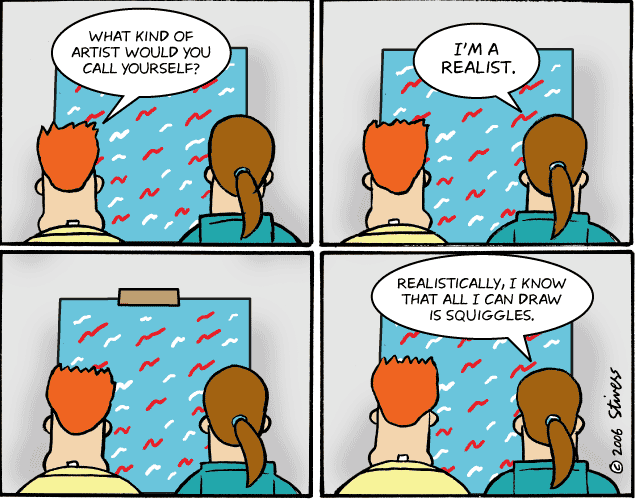
Aristotle believed that humans learn from what their senses perceive. As you experience objects, you are able to understand concepts about the objects. This idea is different than the idealist, which believes that truth or knowledge about an object can come from the individual. The realist sees that education comes from interaction and experience.


This website gives a quick review of several different philosophies of education. I believe that this approach to education is most influential because it follows along the idea that there is a world out there that exists, and can inspire students to want to learn more about it.
Will this approach work in


Will this approach work in the classroom? If teachers consider using this style of teaching I think they will see positive results with their students. The positive effects of using a realistic approach to education are that students understand that a government-run education system (that exists now) emphasizes a balance in working. This approach also emphasizes that the responsibility of teaching belongs to the state; which is also true to public schools.

Tuesday, March 23, 2010

Inclusion in the classroom: Is it effective for students' learning?


In the text as well as websites such as this, the idea of inclusion in the classroom comes up. It is viewed in some instances as keeping some students at a slower pace in the classroom; but it is also viewed as being helpful to those students with disabilities to experience a classroom setting with their peers sans disabilities. Although this issue seems to be controversial in every way, and I can see both sides of the argument. I think as an educator you should vow to make sure that you are engaging with your students on all levels- and not single any student out. One of our texts states that there are laws to support inclusion in the classroom (McNergney)and that schools however, are given the option to have special education classrooms, and are not required to "include" these students in regular classrooms.


Another website I found discusses 5 Methods of Inclusion and one of the methods, called the Alternative method best exemplifies the positive and negative factors of inclusion. With this style of teaching, there is a larger group with one teacher and a smaller group faced back to back to the other group. The smaller group (if rotated with a mix of all students) is effective to introduce total inclusion. However, what this article does point out,
"In turn, the Alternative Teaching method can cause students to feel alienated or secluded from their classmates, especially if the teachers have a tendency to choose the same students to be in the small group and don’t properly rotate them. Additionally, teachers need to coordinate the appropriate lessons to make sure that all students are getting the same material delivered to them and that they aren’t missing valuable information while receiving extra help."


The idea that inclusion could negatively impact the learning of students is clear from this article, but I am still not entirely convinced that inclusion can be so destructive.

Tuesday, March 2, 2010

Racism in the Classroom- What are teachers saying about this?


When is the last time you had a discussion about racism in your class?

This website I found during research shows a Ten-Point Checklist for students to practice exactly what they can do about racism in the classroom. The most valuable point I thought the checklist mentioned was the idea of a "zero-tolerance policy".
Advocate for a Zero-Tolerance Policy at your school. This means that regardless of how insignificant a racist or discriminatory comment or act might seem, their will be
consequences for it. We must also be aware that Zero-Tolerance does not just apply to
discrimination that takes place on the basis of race. It also incorporates sexism,
homophobia, ageism, discrimination based on religion, able-bodiedness, among others.


When thinking back on my classroom experience I can remember when my teachers would ask if any of us knew what racism was. As a 9-yr-old student I had an idea that racism was bad, but I didn't know exactly what it was. My teacher explained that racism was treating somebody in a bad or a different way because of their color or race. And this was the idea I had of racism. We had group activities to promote anti-racism and we were encouraged to embrace what made us unique. But what did I really learn about racism...that by coloring and making masks that I could make an actual difference in stopping the racism that goes in within schools at least? No. I wish I had teachers that spoke to the class in a way that effectively showed us how to make a difference. One of the websites I found showed some ways in which racism can be taught and understood in the classroom.


HOW CAN ADMINISTRATORS PREVENT RACISM?


1. Articulate a clear statement of expectations regarding racism.

2. Establish and enforce a series of consequences for violations of those expectations.

3. Respond to racial incidents quickly and fairly by gathering adequate evidence. Correction should be remedial.

4. Discourage students from congregating on the school grounds according to race.

5. Design seating assignments with a priority on integration.

6. Rely on peer counseling whenever possible.

7. Seek advice and support from parent and student advisory boards.

8. Enlist the help and advice of key minority leaders in the community for teacher workshops, assemblies, and arbitration of racial incidents when appropriate.

9. Reward those who strive to reduce racism in their schools and classrooms.

10. Hire and assign an appropriate balance of minority faculty and staff to act as role-models and provide an adequate base of authority for policies and discipline.


In addition to this quote, "Educators can employ several strategic, motivational, and confrontational means to change racist behavior. The following list incorporates some steps that have been proved effective" (Diane Pollard 1989, Lloyd Foster 1989, James VanSciver 1989, and others).


I think that teachers should use different methods of teaching about racism so they have a better understanding of it. By using the checklist that the website proposed I think it is a valuable tool to use because it acknowledges that racism exists and helps students realize what they can do to make a difference.

Monday, February 22, 2010

Do dress codes help make schools better?


How many of you were given dress code guidelines while in elementary and high school? Were you allowed to wear hats, hooded sweat shirts, or any shirt that had suggestive writing on it?

It seems as though many schools are concerned with what their students are wearing and are looking into whether or not this affects their learning. I went to a private school and wore a uniform for 7 years then changed to public school and was able to wear almost anything I wanted. Except one day I wore a hooded sweatshirt to school and was told I had to take it off or that I would be asked to go to the office. I was shocked that I was not able to wear it, and learned that it was because several students in the past were putting things in their hoods that weren't allowed in school.

Dress codes and uniforms can help reduce the potential for conflict by;

1. Reducing conflict stemming from socio-economic status, i.e., conflicts stemming from comments and personal attacks about who has better clothing and so on.

2. Reducing ways in which gang members can identify themselves which, in essence, is a form of intimidation and creates fear.

3. Reduces the risk of students being robbed to and from school, or for that matter in school, of expensive clothing, jewelry, etc.

4. In the case of uniforms, could help school administrators identify non-students, trespassers, and other visitors in the hallways who stand out in the crowd.


To go along with the above excerpt, I think that it is agreeable to have a separation in clothing between the staff and students at any school. However are teachers wearing the ripped jeans and tees that students wear to class in high school? The last time I checked I don't think they were. Teachers have always been noticeably and differently dressed than their students. The next valid point this article seemed to have was in reaction to violence in schools. If schools adhere to strict dress codes or have uniforms than they are able to control many factors in a students life; at least while in their school. At my school- the "no hoods" policy was in reaction to contraband material being brought into school. And in research of uniforms, and while looking for any statistic that would lead me to believe that uniforms did help with eliminating violence, I found this: In Long Beach California they instituted uniforms in 1994 and have seen attendance sky rocket and gang crimes at school drop 76%.

So given this information about why dress codes/ uniforms do make schools better, do you think that it is a wise decision for all schools to consider making this into their own policy, or not?