Search This Blog

Tuesday, March 30, 2010

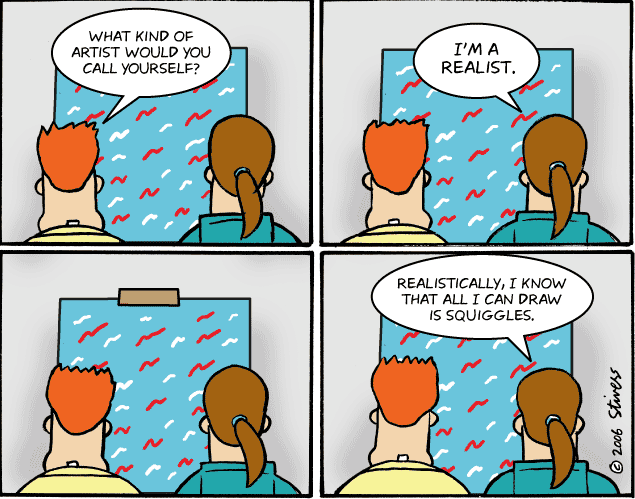
Realist Approach to Education


Aristotle believed that humans learn from what their senses perceive. As you experience objects, you are able to understand concepts about the objects. This idea is different than the idealist, which believes that truth or knowledge about an object can come from the individual. The realist sees that education comes from interaction and experience.


This website gives a quick review of several different philosophies of education. I believe that this approach to education is most influential because it follows along the idea that there is a world out there that exists, and can inspire students to want to learn more about it.
Will this approach work in


Will this approach work in the classroom? If teachers consider using this style of teaching I think they will see positive results with their students. The positive effects of using a realistic approach to education are that students understand that a government-run education system (that exists now) emphasizes a balance in working. This approach also emphasizes that the responsibility of teaching belongs to the state; which is also true to public schools.

Tuesday, March 23, 2010

Inclusion in the classroom: Is it effective for students' learning?


In the text as well as websites such as this, the idea of inclusion in the classroom comes up. It is viewed in some instances as keeping some students at a slower pace in the classroom; but it is also viewed as being helpful to those students with disabilities to experience a classroom setting with their peers sans disabilities. Although this issue seems to be controversial in every way, and I can see both sides of the argument. I think as an educator you should vow to make sure that you are engaging with your students on all levels- and not single any student out. One of our texts states that there are laws to support inclusion in the classroom (McNergney)and that schools however, are given the option to have special education classrooms, and are not required to "include" these students in regular classrooms.


Another website I found discusses 5 Methods of Inclusion and one of the methods, called the Alternative method best exemplifies the positive and negative factors of inclusion. With this style of teaching, there is a larger group with one teacher and a smaller group faced back to back to the other group. The smaller group (if rotated with a mix of all students) is effective to introduce total inclusion. However, what this article does point out,
"In turn, the Alternative Teaching method can cause students to feel alienated or secluded from their classmates, especially if the teachers have a tendency to choose the same students to be in the small group and don’t properly rotate them. Additionally, teachers need to coordinate the appropriate lessons to make sure that all students are getting the same material delivered to them and that they aren’t missing valuable information while receiving extra help."


The idea that inclusion could negatively impact the learning of students is clear from this article, but I am still not entirely convinced that inclusion can be so destructive.

Tuesday, March 2, 2010

Racism in the Classroom- What are teachers saying about this?


When is the last time you had a discussion about racism in your class?

This website I found during research shows a Ten-Point Checklist for students to practice exactly what they can do about racism in the classroom. The most valuable point I thought the checklist mentioned was the idea of a "zero-tolerance policy".
Advocate for a Zero-Tolerance Policy at your school. This means that regardless of how insignificant a racist or discriminatory comment or act might seem, their will be
consequences for it. We must also be aware that Zero-Tolerance does not just apply to
discrimination that takes place on the basis of race. It also incorporates sexism,
homophobia, ageism, discrimination based on religion, able-bodiedness, among others.


When thinking back on my classroom experience I can remember when my teachers would ask if any of us knew what racism was. As a 9-yr-old student I had an idea that racism was bad, but I didn't know exactly what it was. My teacher explained that racism was treating somebody in a bad or a different way because of their color or race. And this was the idea I had of racism. We had group activities to promote anti-racism and we were encouraged to embrace what made us unique. But what did I really learn about racism...that by coloring and making masks that I could make an actual difference in stopping the racism that goes in within schools at least? No. I wish I had teachers that spoke to the class in a way that effectively showed us how to make a difference. One of the websites I found showed some ways in which racism can be taught and understood in the classroom.


HOW CAN ADMINISTRATORS PREVENT RACISM?


1. Articulate a clear statement of expectations regarding racism.

2. Establish and enforce a series of consequences for violations of those expectations.

3. Respond to racial incidents quickly and fairly by gathering adequate evidence. Correction should be remedial.

4. Discourage students from congregating on the school grounds according to race.

5. Design seating assignments with a priority on integration.

6. Rely on peer counseling whenever possible.

7. Seek advice and support from parent and student advisory boards.

8. Enlist the help and advice of key minority leaders in the community for teacher workshops, assemblies, and arbitration of racial incidents when appropriate.

9. Reward those who strive to reduce racism in their schools and classrooms.

10. Hire and assign an appropriate balance of minority faculty and staff to act as role-models and provide an adequate base of authority for policies and discipline.


In addition to this quote, "Educators can employ several strategic, motivational, and confrontational means to change racist behavior. The following list incorporates some steps that have been proved effective" (Diane Pollard 1989, Lloyd Foster 1989, James VanSciver 1989, and others).


I think that teachers should use different methods of teaching about racism so they have a better understanding of it. By using the checklist that the website proposed I think it is a valuable tool to use because it acknowledges that racism exists and helps students realize what they can do to make a difference.